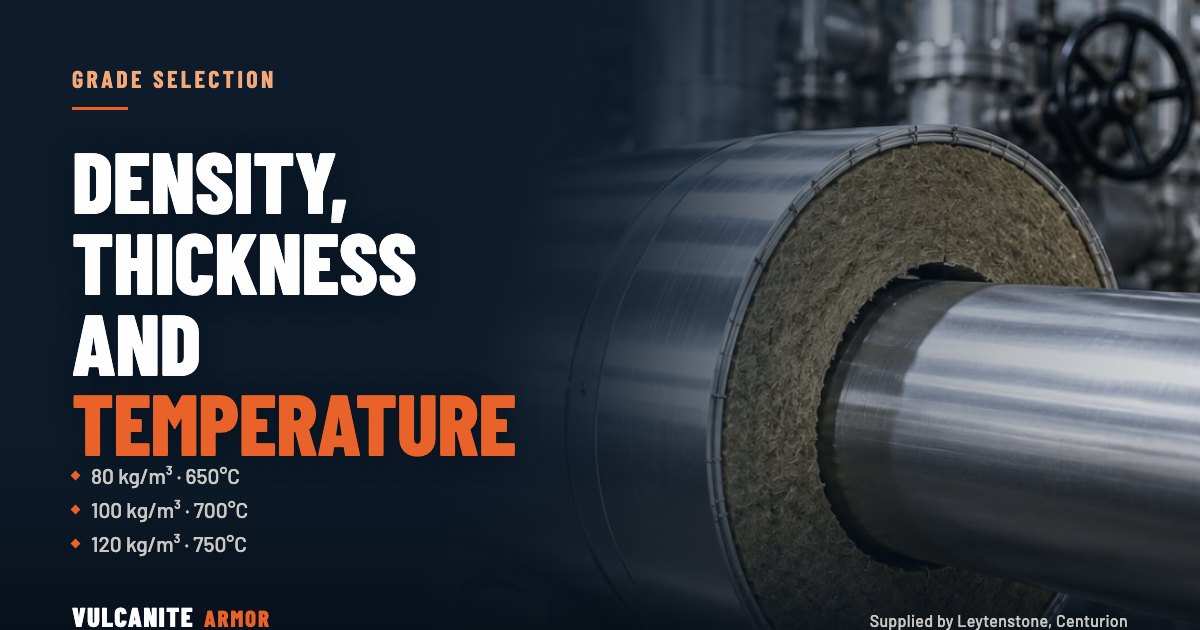
On a hot industrial line the density question answers itself: pick the grade from the hot-face temperature, and the density comes with it. Vulcanite Armor rock wool blanket is published at 80 kg/m³ for 650°C, 100 kg/m³ for 700°C and 120 kg/m³ for 750°C hot-surface performance per ASTM C411 / C447. Thickness follows the duty. Width follows the geometry.
The keyword traffic runs the other way: buyers search on density first. A specifier who starts from density compares two numbers that were never independent on this range, while the hot-face temperature of the line sits unexamined in the process data. The three steps run the same way on a condensate header and on a flue casing, and they are the whole of specifying high temperature insulation on this range: Blanket 80, 100 or 120.
Start with the line temperature, not the density
On this range density and hot-surface performance are published as a pair and move together: 80 kg/m³ with 650°C, 100 kg/m³ with 700°C, 120 kg/m³ with 750°C. Choosing against the temperature has therefore already chosen the density. Density is the label on the grade, not the criterion you select on.
Where the line temperature clears all three published figures, the temperature step has stopped deciding. The default is then the lowest grade that clears it, because no per-grade mechanical figure is published to override that, and the remaining difference between the grades is price per roll on the published price list.
What each grade is rated to
| Grade | Density (EN1602) | Hot-surface performance (ASTM C411 / C447) |
|---|---|---|
| rock wool blanket 80 kg/m³ | 80 kg/m³ | 650°C |
| rock wool blanket 100 kg/m³ | 100 kg/m³ | 700°C |
| rock wool blanket 120 kg/m³ | 120 kg/m³ | 750°C |
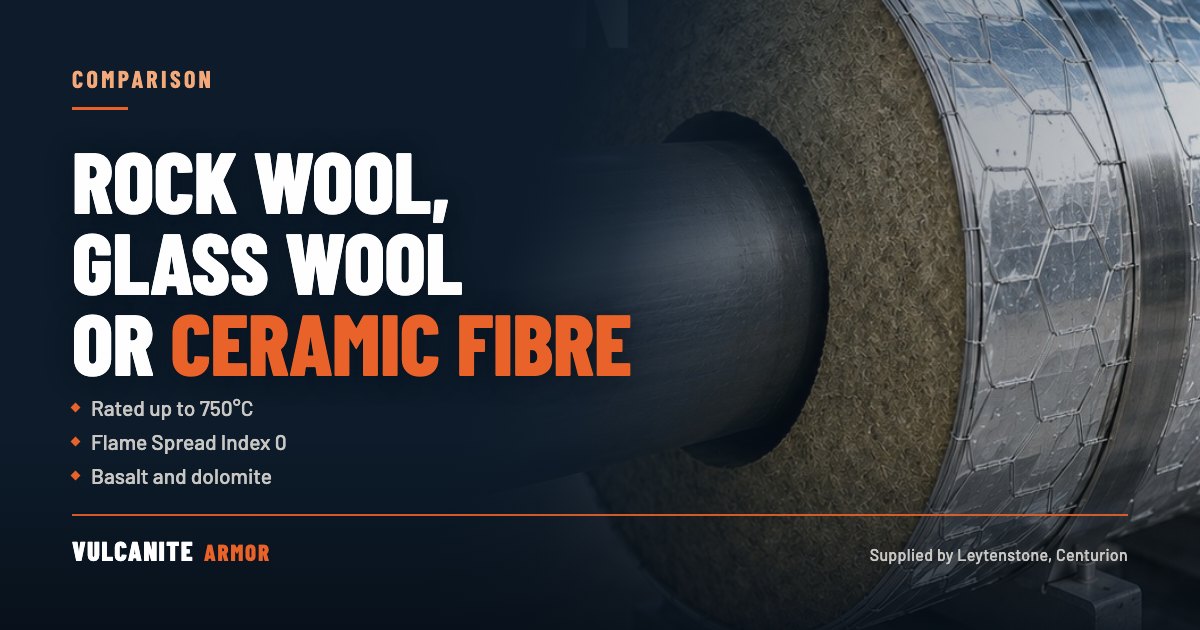
The range is rated up to 750°C. That 750°C figure belongs to Blanket 120 and to no other grade, so the range statement and the grade statement stay separate sentences.
Hot-surface performance is a tested property, not a headline number
Two methods sit behind those figures. Hot-surface performance is measured under ASTM C411, Standard Test Method for Hot-Surface Performance of High-Temperature Thermal Insulation. Maximum use temperature is handled under ASTM C447, Standard Practice for Estimating the Maximum Use Temperature of Thermal Insulations. The operative word in that second printed title is “estimating”: a maximum use temperature is an estimate, not a guarantee about your line.
Where the published figure stops
The datasheet says this itself: its technical data comes from controlled laboratory testing under ideal conditions, and it advises independent testing where operating conditions are uncertain. That disclaimer is an instruction rather than boilerplate. A cyclic line, a line with an unknown upset case, or a casing whose hot face has never been measured has uncertain conditions.
What density actually changes
More fibre per cubic metre
Density is published per EN1602 and is the grade label: 80, 100 or 120 kg/m³. For the melt and collection stages behind the blanket, see what rock wool is made of. For the applications each grade’s published list covers, see what rock wool is used for.
Compression behaviour under cladding is not published per grade on the Vulcanite Armor datasheet, so this post makes no comparative mechanical claim between the three grades. On a wire-mesh stitched blanket it is the mesh that lets a flexible mat follow conical, cylindrical and irregular geometry: ask before assuming a heavier grade installs differently.
Thermal conductivity, and why k rises with mean temperature
Thermal conductivity, the k-value, is the number a heat loss calculation consumes. Everything else in a thickness calculation is a condition; k is the material property. It is published per grade across a temperature range on the Vulcanite Armor datasheet, tested per ASTM C335/C335M, Standard Test Method for Steady-State Heat Transfer Properties of Pipe Insulation. The figures stay on the datasheet: a k-value quoted without its grade and its temperature is worse than no figure.
The reason k is published against temperature is physical. Heat crosses a fibrous blanket by conduction through the gas and the solid fibres and by radiation between fibres, and NASA’s work on fibrous insulations records that radiation’s significance rises as temperature rises and falls as density rises. The radiative term climbs steeply because radiative heat flux carries a cube-of-absolute-temperature factor. Separately, the same NIST work finds that in high-density fibrous insulation near ambient temperature the dominant mechanism is conduction through the gas and the solid fibres. The k-value that describes a blanket at a warm mean temperature therefore does not describe it at a hot one, and the calculation takes the value at the mean temperature it is working at.
Because radiation falls with density while solid conduction rises with it, effective conductivity passes through an optimum whose position depends on the material (that work studies ceramic fibrous insulations rather than rock wool, so the mechanism transfers and the materials do not). No published source locates it for rock wool, so this post places no grade on that curve.
What density does not tell you
Density on its own does not set a thickness, does not set the temperature limit without the test method beside it, and is not an acoustic rating. Why density is not an acoustic rating on this range, and what the material is doing in a cavity or an enclosure, is set out in rock wool for sound insulation.
Choosing thickness: the four questions that set it
Thickness is calculated against a duty, and the industry recognises four. The US National Insulation Association lists the primary reasons for insulating as process control, personnel protection, condensation control and energy savings, setting aside the specialty cases of noise reduction and fire protection. The same article makes the structural point: one heat transfer calculation serves all four, and what changes between them is the target value fed in, not the physics.
- Process control: holding the process temperature along the run.
- Personnel protection: keeping the cladding surface below a contact-burn threshold.
- Condensation control: keeping the surface above the dew point of the surrounding air.
- Energy savings: buying back the fuel cost of the heat leaving the line.
The calculation practice has a designation: ASTM C680, Standard Practice for Estimate of the Heat Gain or Loss and the Surface Temperatures of Insulated Flat, Cylindrical, and Spherical Systems by Use of Computer Programs, current as C680-23a. Two things in that title matter: the word “Estimate”, and the separation of flat, cylindrical and spherical systems, which is the standard’s own acknowledgement that geometry changes the answer. On the specifying side, BS 5422:2023, Thermal insulating materials for pipes, tanks, vessels, ductwork and equipment operating within the temperature range –40 °C to +700 °C. Method for specifying, is the current British method and superseded BS 5422:2009.
Process control
The first duty is holding the process where the process engineer put it: temperature at the far end of a long run, viscosity in a heavy product line, a reaction inside its window. The target is a permitted temperature drop along a length rather than a heat loss figure, so the length of the run is an input in a way it is not for the other three duties.
Personnel protection and surface temperature
The second duty is keeping the outside of the cladding cool enough to touch. ASTM C1055, Standard Guide for Heated System Surface Conditions that Produce Contact Burn Injuries, is the standard guide for this question.
There is no single safe touch temperature. A burn threshold is defined against a stated contact period and falls as that period lengthens. CENELEC Guide 29, published in 2007, gives a burn threshold for uncoated metal of 51°C at one minute of contact, 48°C at ten minutes and 43°C at eight hours or longer, and varies it by surface material: at one minute it publishes 51°C for metal, 56°C for ceramics, glass and stone, and 60°C for plastics and wood. For contacts of one to ten seconds it gives spreads on a graph rather than single numbers. Check its scope before it reaches a specification: it addresses electrical equipment under the Low Voltage Directive, not industrial pipework, so the physiology transfers and the application does not.
Separately, the insulation industry reports 140°F, which is 60°C, as a commonly specified maximum allowable surface temperature (NIA, 2007). That is a design specification, not a safety threshold set by a standard.
Condensation control
The third duty applies on cold and ambient-adjacent service, where the criterion is the dew point of the surrounding air rather than a heat loss figure. NIA records that on below-ambient lines preventing surface condensation is the overriding concern in almost all applications, so the calculation needs an ambient temperature and a relative humidity. The US Department of Energy also advises that damaged or wet insulation be repaired or replaced and the source of moisture eliminated first, because wet insulation loses insulating value.
Energy savings, and economic thickness inside it
The fourth duty is money: the heat leaving the line has a fuel cost, and thickness buys it back. Economic thickness is not a fifth duty. It is the costing method that turns the energy question into a number, defined by NIA as the thickness that balances energy savings against first cost plus the maintenance cost of the installed system. It needs three inputs no supplier holds: your fuel cost, your annual operating hours, and the payback period your finance function accepts.
Why there is no rock wool thickness chart on this page
Because the answer moves with inputs that belong to your site. NIA’s own worked case prints its assumptions as a list: average pipe temperature, average ambient temperature, average wind speed, nominal pipe size and jacketing emissivity. The DOE’s published heat loss table states its assumptions the same way, a horizontal steel pipe at 75°F ambient with no wind velocity and 8 760 operating hours per year. Change the orientation, the wind or the cladding and the table describes a different line, which is why NIA advises specifiers to regenerate old thickness tables against current energy costs rather than reuse them.
A printed lookup table would therefore be a guess wearing a number, and a calculator on this page would be the same guess with an interface. Run ASTM C680 against your own conditions, or send us the line temperature, the pipe diameter and the ambient conditions and get a quote carrying the grade and a thickness band.
Choosing width and roll size
600 mm or 1200 mm
Vulcanite Armor publishes two widths, and no published rule allocates one to a pipe size.
A 600 mm roll wraps a small-bore pipe in fewer part-width cuts, because the circumference of a small pipe plus its overlap is often closer to 600 mm than to 1200 mm, and every part-width cut leaves an offcut and a hand-trimmed edge. A 1200 mm roll covers a vessel wall or flat casing in fewer passes, so there are fewer circumferential joints per square metre to stagger, wire and seal. On a mixed site the deciding factor is which geometry dominates the scope. Both widths are published in the same three grades, so this is a cutting and jointing decision rather than a grade decision.
The published size envelope
| Property | Published value | Standard or note |
|---|---|---|
| Thickness | 30 to 100 mm | Datasheet |
| Width | 600 or 1200 mm | Datasheet |
| Roll length | 2,5 to 5 m | Datasheet |
| Density, standard grades | 80, 100, 120 kg/m³ | EN1602 |
| Density, on request | 40 to 120 kg/m³ | Made to order, lead time on request |
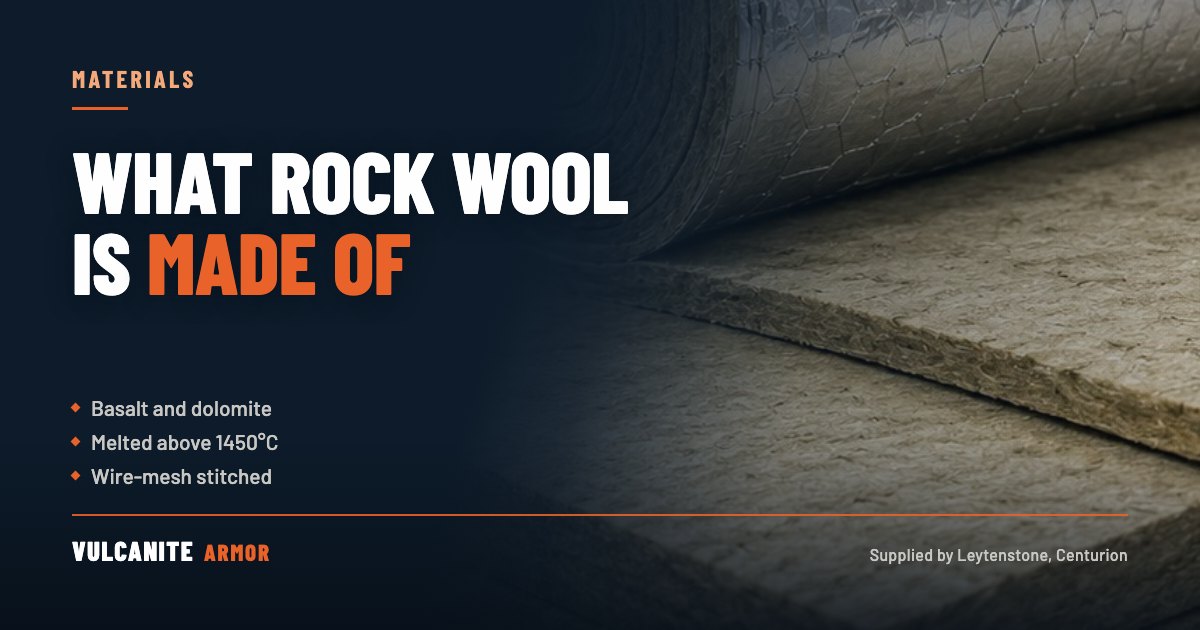
| Mesh | Galvanised or stainless steel, 24# or 22# wire, 1 inch mesh | Datasheet |
Within the published 30 to 100 mm range, 50 mm, 75 mm and 100 mm are the thicknesses most often specified. None of the three is a default: the figure comes out of the calculation above, not off a list.
Both mesh options are published and the datasheet names neither as standard, so state the mesh you need on the order.
Working three lines through the three steps
A hot water or condensate line at about 180°C
All three grades carry a published hot-surface performance well above 180°C, so the temperature step decides nothing here. Nothing in this post separates the three grades on mechanical duty, because compression behaviour under cladding is not published per grade. The default is therefore the lowest grade that clears the temperature, and all of the three Vulcanite Armor grades can be costed against each other on the price list.
The binding thickness question at this temperature is usually personnel protection or condensation control rather than energy savings, because the temperature difference driving the loss is small and the surface is often in reach. Width is geometry: the arithmetic set out above applies here, and no published rule allocates a width to a pipe size. Still open: ambient temperature, wind exposure, cladding emissivity and the surface temperature target in the specification. The thickness comes out of a calculation against those, not out of this paragraph.
A steam line at about 480°C
480°C sits below the published hot-surface performance of all three grades. The two numbers to compare are the measured hot-face temperature of the line and the hot-surface figure for the grade, tested per ASTM C411 / C447. This post offers no numeric margin between them, because none is published on the datasheet and an unsourced margin is an invented number. The datasheet offers its own disclaimer instead: where operating conditions are uncertain, test independently.
The energy question is live here in a way it was not at 180°C, because the temperature difference driving the loss is far larger. Where the line also runs continuously, that is the case economic thickness was built for, and it needs your fuel cost, your operating hours and your payback period. Width follows the geometry as before. Not yet fixed by this example: whether the line is trace heated, whether it cycles, and whether the specification carries a surface temperature limit. The thickness is an ASTM C680 output against those conditions.
Furnace or flue casing at about 700°C
700°C is the published hot-surface performance of rock wool blanket 100 kg/m³, and rock wool blanket 120 kg/m³ is published at 750°C. This is the example where temperature genuinely makes the grade decision: a line running at the same number as a published rating is a case for an engineer and a measured hot-face temperature, not for a cart.
Flat casing changes the geometry input, which is why ASTM C680 separates flat from cylindrical systems in its own title, and at this hot-face temperature the surface temperature question tends to be binding. The 1200 mm width covers flat casing in fewer joints per square metre. Above the published range the material class changes rather than the grade: where rock wool’s published figures stop, other insulation classes begin. The bands are set out in rock wool vs glass wool vs ceramic fibre. The example cannot close until three figures arrive: the measured hot-face temperature, the casing orientation, and whether the duty is cyclic.
What to check on the datasheet before you raise the order
Run this against any supplier’s sheet, not only ours. Five lines carry the evidence a plant QA file asks for.
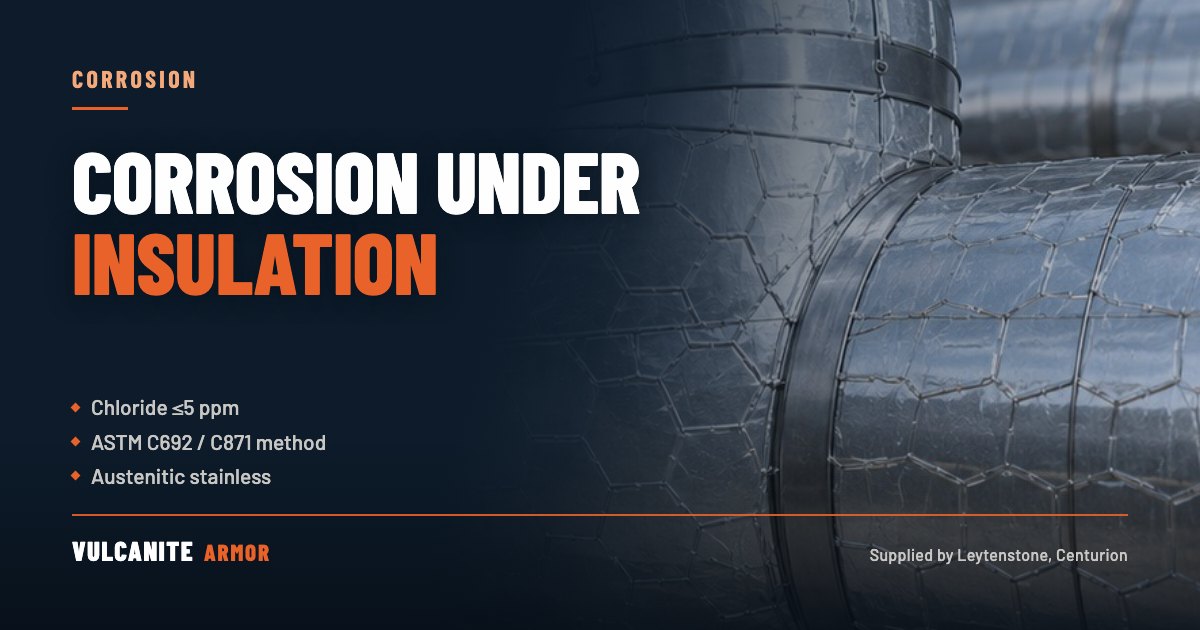
First, the hot-surface figure for your grade with its test method printed beside it: a temperature with no method next to it is an adjective. Second, the density figure with EN1602 beside it. Third, the compliance specification and type: Vulcanite Armor is compliant with ASTM C592 Type I and III, Standard Specification for Mineral Fiber Blanket Insulation and Blanket-Type Pipe Insulation (Metal-Mesh Covered) (Industrial Type). Fourth, the chloride figure in ppm with its method: Vulcanite Armor publishes chloride ion content of 5 ppm or less and conforms to the stainless steel corrosion specification as per ASTM C692 and C871 test method. Fifth, water absorption: less than 1 kg/m² by partial immersion, tested to EN1609 / BS 2972.
Two more lines are worth finding: the fire line, Flame Spread Index 0 and Smoke Developed 20, tested per ASTM E84, and the mesh specification, because galvanised and stainless are different orders. Prices per roll for all three grades are on the published price list, so the grade can be costed before the requisition is raised.
Getting the grade and the band for your line
Download the Vulcanite Armor datasheet for the published parameters on all three grades, including the conductivity figures across the temperature range.
If you send us the line temperature, the pipe diameter, the ambient conditions and any surface temperature limit in the specification, get a quote and we will confirm the grade and a thickness band.
Frequently asked questions
How thick should rock wool insulation be on a hot line?
Thickness is calculated, not looked up. Four duties set the target: process control, personnel protection, condensation control and energy savings. Each one needs the line temperature, the ambient temperature, the wind speed, the pipe size and the emissivity of the cladding before it returns a number. ASTM C680 is the standard practice for that calculation. Send us the line conditions and we will come back with the grade and a thickness band.
Is 100 mm rock wool enough?
100 mm is a thickness, not an answer. Whether it is enough depends on what the thickness is being sized against: a heat loss target, a surface temperature limit, a dew point, or a payback period. 100 mm is the top of the published Vulcanite Armor thickness range, and the three grades are 80, 100 and 120 kg/m³ per EN1602.
Which rockwool density do I need for a 500°C line?
On this range the temperature choice is the density choice, so ask the temperature question first. Vulcanite Armor publishes hot-surface performance of 650°C for Blanket 80, 700°C for Blanket 100 and 750°C for Blanket 120, per ASTM C411 / C447. A 500°C line sits below all three published figures. Where a line runs at a published figure, take the measured hot-face temperature to an engineer.
What is the density of 50 mm rock wool?
Thickness and density are independent variables, so 50 mm has no single density. Vulcanite Armor is published at 30 to 100 mm thickness across three grades: 80, 100 and 120 kg/m³, measured per EN1602. Custom densities from 40 to 120 kg/m³ are available on request, made to order, lead time on request.
What should a rockwool insulation specification list?
Five lines carry the evidence a plant QA file asks for: the hot-surface figure for the grade with its test method beside it, the density figure with EN1602 beside it, the compliance specification and type, the chloride figure in ppm with its method, and water absorption. The fire line and the mesh specification are worth finding too.
Do you need an air gap with rock wool insulation?
The air gap question comes from cavity work and does not transfer to a hot line. The Vulcanite Armor datasheet publishes its own sequence instead: cut to length with slight pre-stress, stagger the joints by at least 30 degrees, wire the joints closed, then fit the metal cladding. That is installation practice rather than a performance claim.
Published by Vulcanite, supplier of Vulcanite Armor rock wool insulation.
Need help choosing a grade?
Prices per roll are published for all three grades, or email us your hot-face temperature, dimensions and roll count for a written quote.