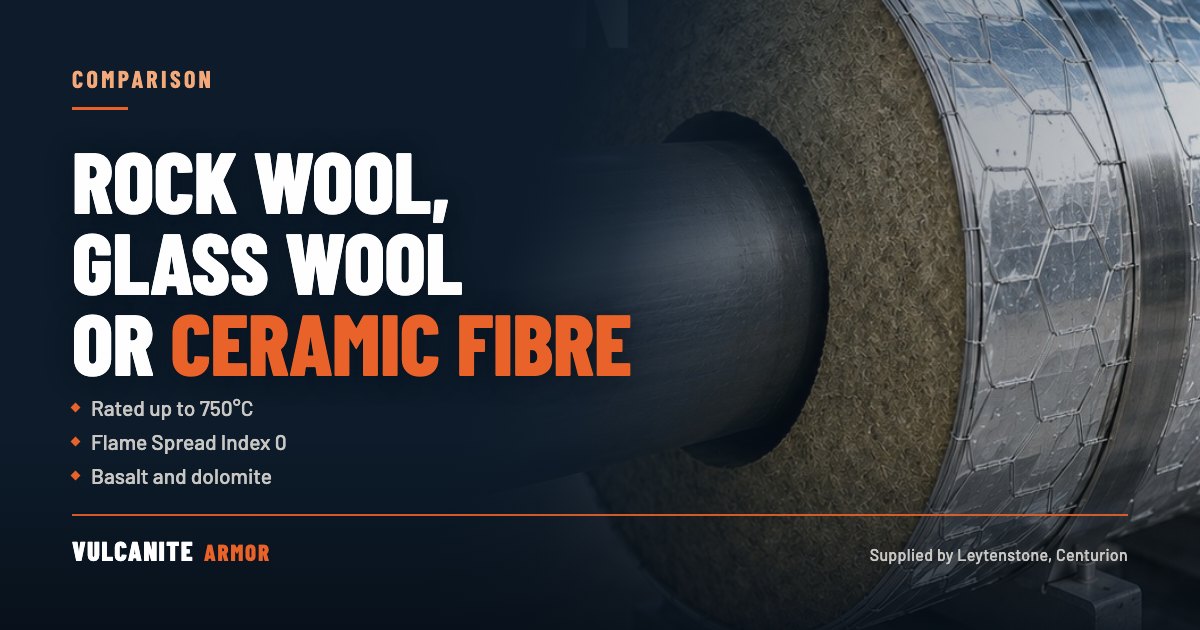
Rock wool is a mineral fibre spun from molten rock. The feedstock is an igneous silicate rock, usually basalt, melted with a carbonate flux such as limestone or dolomite, and in many plants with blast furnace slag as well. The melt is thrown into fibre on spinning wheels, sprayed with a binder, then cured and cut.
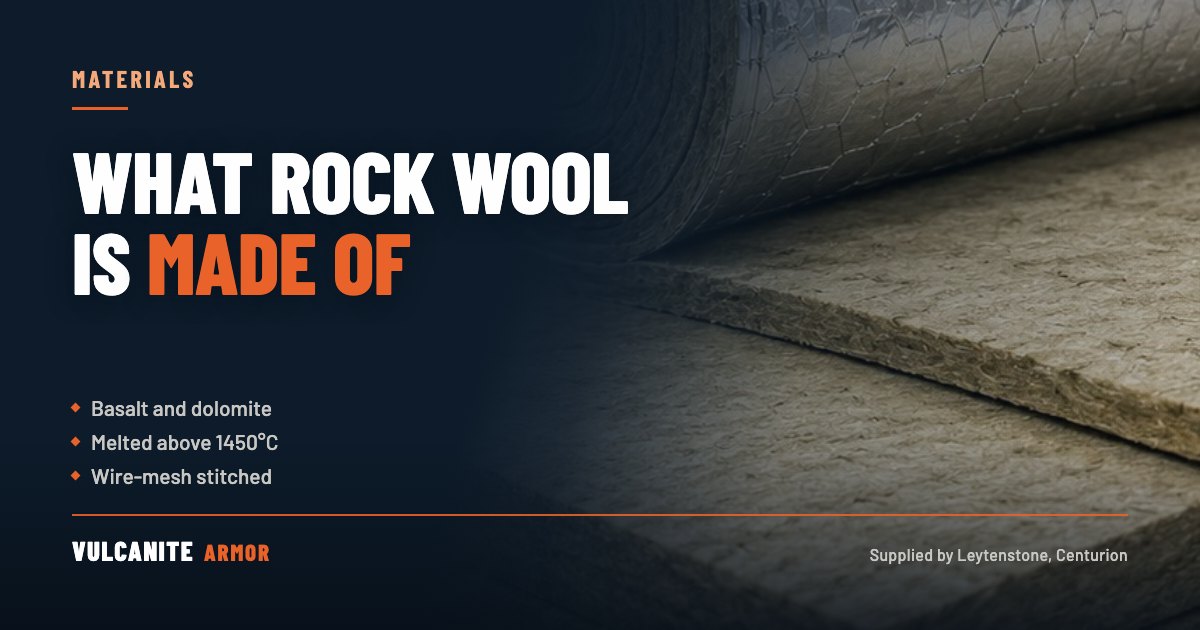
That is the generic answer. It is not enough to put a blanket into a job file. Which rock, which flux and whether any slag went into the melt varies between makers, and the datasheet is the only place you find out. Vulcanite Armor publishes its pair: high quality basalt and dolomite.
What rock wool is made of
Two things go into a rock wool furnace: a rock that supplies the silicate backbone of the fibre, and a carbonate that corrects the chemistry of the melt. A third input, blast furnace slag, goes into the melt at many plants.
Basalt, the rock that goes into the furnace
Basalt is an alumino-silicate rock. IARC records that the traditional raw materials for rock wool are basalt or diabase, mixed with limestone or dolomite as fluxing agents, and that basalt is usually the primary raw material. Vulcanite Armor’s datasheet names basalt as its rock input.
Dolomite and the role of the flux
Dolomite is a calcium-magnesium double carbonate, CaCO3·MgCO3. IARC describes the balancing principle: one raw material is the main component, and others are added to correct a deficiency in it, so a charge too rich in acid oxides such as silica takes a calcium-oxide-rich addition. Work on alumino-silicate glasses relevant to fibre production also found that dolomite reduces viscosity, which the authors describe as beneficial for mineral fibre production. That study melted amphibolite rather than basalt, so read it as the general principle, not as a measurement of any particular melt.
Slag, and why the feedstock differs between makers
Slag is a by-product of iron and steel making. The US EPA records that mineral wool is defined as a fibrous glassy substance made from natural rock such as basalt or diabase, or from mineral products such as slag and glass. IARC records that rock wool plants melt a combination of alumino-silicate rock, blast furnace slag and limestone or dolomite. IARC also puts the naming rule plainly: where blast furnace slag is the primary component the product is slag wool, and where basalt is the primary component it is rock wool or stone wool. Neither name is a verdict on quality: both describe what was charged into the furnace.
The Vulcanite Armor datasheet names basalt and dolomite. It does not mention slag either way, and absence of a mention is not evidence of absence, so we do not claim the blanket is slag free. If slag content is a line item in your specification, email us and we will ask the supplier.
What else is in the roll
The fibre is not the whole product. EPA and IARC both record that an oil is applied to suppress dust, and that a binder, typically a phenol-formaldehyde resin, is sprayed onto the airborne fibre to give the mat structural rigidity. IARC puts binder content in rock and slag wools at up to 10% of the mass of the finished product. Those are industry figures, not Vulcanite Armor figures: the datasheet states that a binder, a dustproof oil and a water repellent are sprayed during collection, and publishes no chemistry and no percentage for any of them. The last component is the facing. Vulcanite Armor is stitched to galvanised mesh or stainless steel mesh, commonly 24# wire with 1” mesh or 22# wire with 1” mesh.
How rock wool is made, step by step
EURIMA describes mineral wool production as a sequence of consecutive melting, fiberisation, curing, cutting and packaging. Each stage sets a property you can later read off a datasheet.
Melting the batch
EPA describes the rock and slag route as a coke-fired cupola charged in alternating layers of mineral and coke, with the charge heated to the molten state at 1300 to 1650°C. For stone wool specifically, IARC records a melt temperature of 1500 to 1550°C as the figure normally used. The Vulcanite Armor datasheet gives its own melt as higher than 1450°C, which sits inside the published industry range. That is the only comparison worth drawing from the number.
Spinning the melt into fibre
The melt leaves the furnace through a notch and falls onto the rapidly rotating wheels of a spinning machine, which throw it off as a fine spray of fibre. Air blasted from behind the wheels attenuates the fibres and carries them to the collection belt. IARC describes that route for rock and slag wool. Not all of the melt becomes fibre: EPA notes that the globules which never form into fibre are called shot. The Vulcanite Armor datasheet describes its own equipment as a four-axis centrifuge running at high speed. That is the datasheet’s wording. No published source describes what the four axes do, so we do not offer a mechanical explanation of it here.
Collecting the fibre: pendulum and 3D
Below the collector, fans draw the coated fibres down onto a conveyor, and EPA records that conveyor speed is what sets blanket thickness. IARC adds that the primary mat is layered to give the product its required weight per unit area. The Vulcanite Armor datasheet calls its collection stage the pendulum three-dimensional method, and states that the binder, dustproof oil and water repellent are sprayed while the fibres are being collected.
Binding, curing and finishing
The mat passes through a curing oven where the binder is baked and the thickness is set. EPA gives a hot air range of 150 to 320°C for that stage, and EURIMA gives around 200°C in the glass wool section of its process page. The product is then cooled and cut. EURIMA records that the same line is cut into rolls, batts and boards. Those are products of the process in general: Vulcanite Armor is supplied as a wire-mesh stitched blanket only. Its datasheet describes the finishing sequence as cured, solidified and cut.
Why 1450°C is a manufacturing number and not a temperature rating
The melt temperature describes a furnace. The blanket never sees it again, and no part of that number carries into service. The figure should never be read as a product rating.
Service performance is a separate property with its own test methods. Hot-surface performance is measured under ASTM C411, Standard Test Method for Hot-Surface Performance of High-Temperature Thermal Insulation. Maximum use temperature is handled by ASTM C447, Standard Practice for Estimating the Maximum Use Temperature of Thermal Insulations. The operative word in that second title is “estimating”.
| Grade | Density | Hot-surface performance |
|---|---|---|
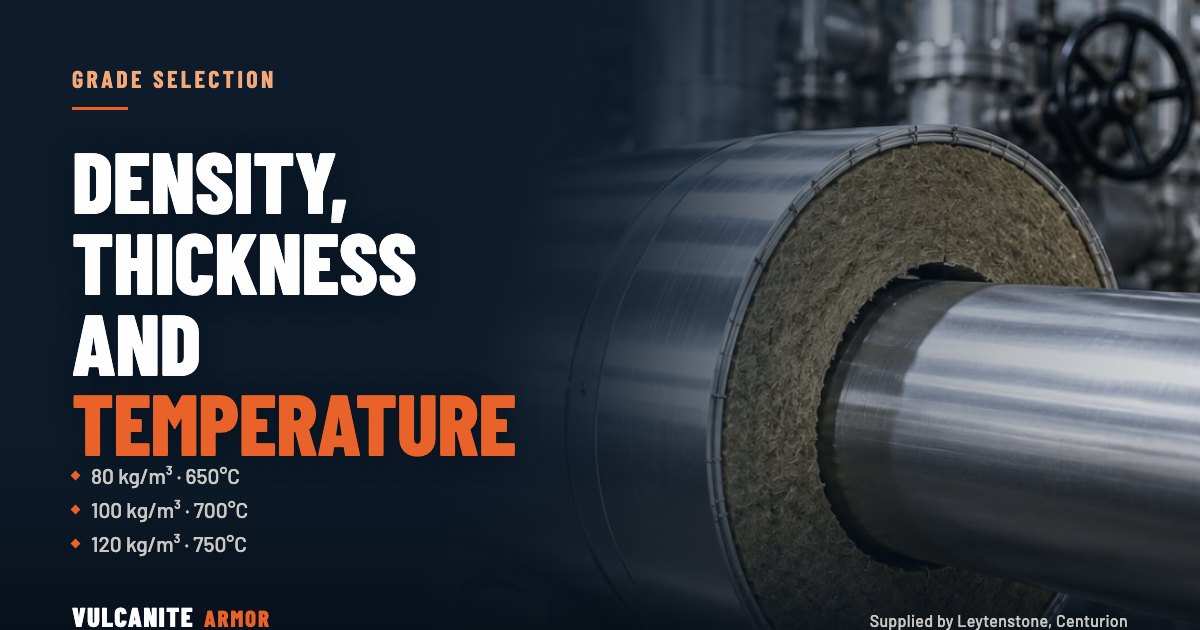
| Vulcanite Armor Blanket 80 | 80 kg/m³ | 650°C per ASTM C411 / C447 |
| Vulcanite Armor Blanket 100 | 100 kg/m³ | 700°C per ASTM C411 / C447 |
| Vulcanite Armor Blanket 120 | 120 kg/m³ | 750°C per ASTM C411 / C447 |
The range is rated up to 750°C. The 750°C figure belongs to Blanket 120 and to no other grade. The datasheet also states that its technical data comes from controlled laboratory testing under ideal conditions, and advises independent testing where operating conditions are uncertain. Where the operating conditions on a line are uncertain, that disclaimer is the instruction: test independently rather than specify off the published figure.
Rock wool, stone wool, mineral wool: what the three terms mean
These are not three products. Two are the same material and the third is the family both belong to. Mineral wool is made by melting a mineral feedstock and spinning it into fibre, and what separates the members of the family is which mineral dominates the melt: igneous rock, blast furnace slag, or glass.
| Term | What it means | Where you will see it |
|---|---|---|
| Rock wool | Fibre spun from a melt in which rock, usually basalt, is the main component | Product names and industrial datasheets |
| Stone wool | The same material under a second name, used interchangeably with rock wool | IARC’s own heading, “rock (stone) wool” |
| Mineral wool | The parent category, covering rock wool, slag wool and glass wool | Standards titles, regulatory classifications, North American usage |
EURIMA lists glass wool, stone wool and slag wool together as mineral wool insulation, and EPA records that in North America “mineral wool” is commonly used for both rock-fed and slag-fed products. How the three members compare by service temperature is set out in rock wool vs glass wool vs ceramic fibre. This matters when you read a compliance line. ASTM C592, Standard Specification for Mineral Fiber Blanket Insulation and Blanket-Type Pipe Insulation (Metal-Mesh Covered) (Industrial Type), is written around mineral fibre as a class rather than around one feedstock. Vulcanite Armor is compliant with ASTM C592 Type I and III. That line tells you the product meets an industrial blanket specification; the raw material line tells you what went into the melt.
What the feedstock changes when you specify the blanket
Chemistry becomes a purchasing question at three points: what the material can leach onto the pipe, how much fibre there is per cubic metre, and what the supplier is willing to publish.
Chloride content and stainless steel
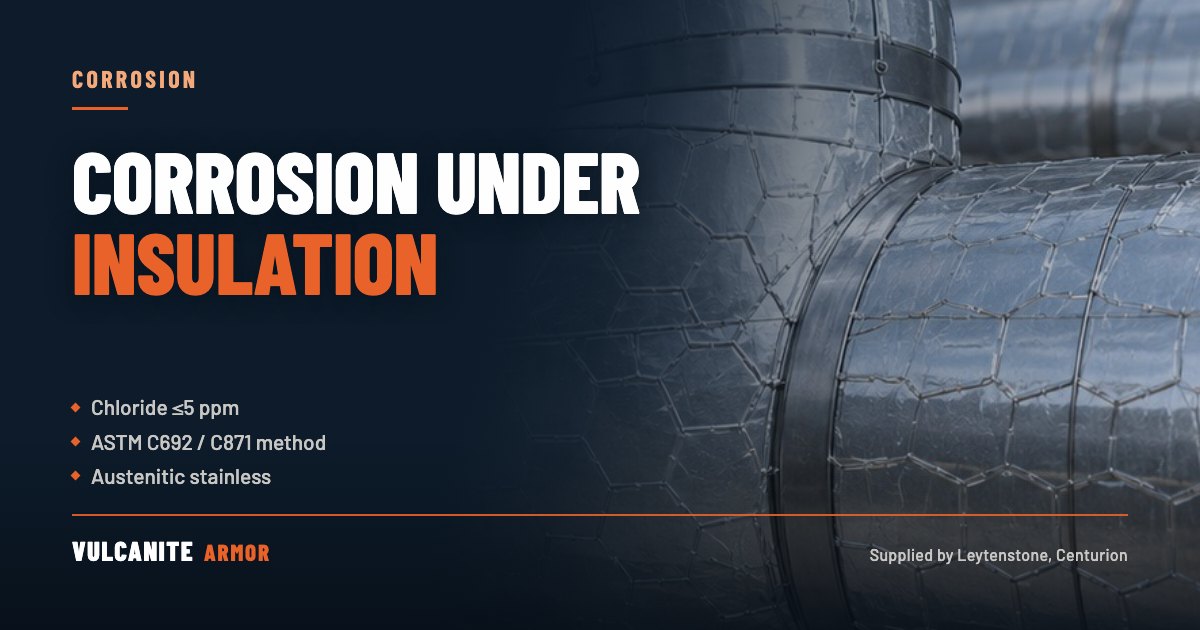
Leachable chloride is the reason feedstock chemistry reaches a QA file at all. The failure mode is named in the title of the test method: ASTM C692, Standard Test Method for Evaluating the Influence of Thermal Insulations on External Stress Corrosion Cracking Tendency of Austenitic Stainless Steel. The chemical analysis sits in ASTM C871, Standard Test Methods for Chemical Analysis of Thermal Insulation Materials for Leachable Chloride, Fluoride, Silicate, and Sodium Ions, which is where the ppm unit on a datasheet comes from, and both sit under ASTM C795, Standard Specification for Thermal Insulation for Use in Contact with Austenitic Stainless Steel. Vulcanite Armor publishes chloride ion content of 5 ppm or less, and the datasheet states that it conforms to the stainless steel corrosion specification as per ASTM C692 and C871 test method. The datasheet publishes the chloride figure only, not sodium or silicate.
Density and what it actually changes
Density is set in manufacture: EPA records that conveyor speed sets blanket thickness and that the blanket is compressed to the appropriate density in the curing oven, and IARC records that the primary mat is layered to give the required weight per unit area. Vulcanite Armor is supplied in three grades, 80, 100 and 120 kg/m³, measured per EN1602, with custom densities from 40 to 120 kg/m³ on request. Compression behaviour under cladding is not published per grade on the datasheet, so specify by the hot-surface figure first and ask before assuming a density difference changes installed thickness. Thermal conductivity is published per grade on the datasheet and is a separate discussion from density alone. Prices per roll for all three grades are on the published price list, so rock wool blanket 100 kg/m³ can be costed against the other two before you specify. Which grade to specify, and the thickness and width that go with it, is covered in choosing rock wool density and thickness.
What to look for on any datasheet
Five lines are worth finding before the material goes into a job file: the named raw materials, the hot-surface figure for your grade with its test method beside it, the chloride figure in ppm with its method, the compliance specification and type, and water absorption. Vulcanite Armor publishes water absorption of less than 1 kg/m² by partial immersion to EN1609 / BS 2972. All of it is on the Vulcanite Armor datasheet, downloadable without a form. The mechanism that the chloride figure speaks to, and what it does not cover, is set out in corrosion under insulation and chloride on stainless steel. Which plant those figures end up on, and which grade each application selects, is set out in what rock wool is used for.
Handling rock wool: what the evidence says
This section is about mineral wool as a material class, reported from its sources. It is not a claim about Vulcanite Armor.
IARC Monographs Volume 81 (2002) states: “Insulation glass wool, continuous glass filament, rock (stone) wool and slag wool are not classifiable as to their carcinogenicity to humans (Group 3).” The same evaluation records inadequate evidence in humans and limited evidence in experimental animals for rock (stone) wool, and places refractory ceramic fibres and special-purpose glass fibres in Group 2B. The previous evaluation of these fibres was Volume 43 (1988).
In the EU, mineral wools carry an Annex VI entry under index number 650-016-00-2 and a Carc. 2 (H351) classification, with Note Q allowing that classification not to apply where defined biopersistence criteria are met. EU-OSHA also records that the effect on skin is mechanical rather than chemical, and that the irritant classification was removed on that basis in 2006.
For practice, EU-OSHA lists ventilated cutting devices, adequate general ventilation, regular removal of dust, and loose-fitting FFP1 respiratory protection with goggles for dusty or overhead work. Construction-industry guidance for pipe, duct and boiler insulation, published in 2005, adds an N95 respirator, dust-resistant safety goggles, loose-fitting full-body clothing and cotton gloves, cutting with a sharp knife rather than tearing by hand, and no dry sweeping, compressed air or leaf blowers for clean-up.
Getting the numbers for your line
Rock wool is basalt and a carbonate flux, melted, spun, bound and cut, and in many plants slag goes in as well. What separates one blanket from another is not the category name but the raw material line, the hot-surface figure per grade and the chloride number, all of which should be printed rather than described.
Download the Vulcanite Armor datasheet for the full technical parameters on all three grades.
If you have a line temperature and a pipe diameter, get a quote and we will confirm the grade and thickness.
Frequently asked questions
What is rockwool insulation made of?
Rock wool is made by melting rock and spinning the melt into fibre. The usual feedstock is basalt or a similar igneous silicate, melted with a carbonate flux such as limestone or dolomite, and in many plants with blast furnace slag as well. The Vulcanite Armor datasheet names high quality basalt and dolomite as its raw materials.
Is rock wool the same as mineral wool?
Rock wool and stone wool are two names for the same material. Mineral wool is the wider category, and it also covers glass wool and slag wool. So every rock wool is a mineral wool, but not every mineral wool is a rock wool. The category name tells you the fibre was made by melting a mineral and spinning it; the rock wool and slag wool names tell you which mineral was the main component of the melt.
Is rock wool made of asbestos?
No. Rock wool is made from melted rock and is a man-made vitreous fibre, while asbestos is a group of naturally occurring crystalline silicate minerals. IARC records that man-made vitreous fibres are amorphous, have no cleavage planes, and break across the fibre into shorter fibres of the same diameter rather than splitting lengthwise into thinner ones.
Can you handle rock wool with bare hands?
Published handling guidance recommends gloves and covering clothing rather than bare hands. EU-OSHA records that the effect of mineral fibre on skin is mechanical rather than chemical. Construction guidance published in 2005 for pipe insulation work lists cotton gloves, loose-fitting full-body clothing, dust-resistant safety goggles and an N95 respirator, with cutting done by sharp knife rather than by tearing.
What happens to rock wool when it gets wet?
Moisture changes the thermal performance of any fibrous insulation. In a 2023 comparison of loose fibrous materials, mineral wool showed the lowest sorption and moisture transport in it stopped fastest. Vulcanite Armor publishes water absorption of less than 1 kg/m² by partial immersion, tested to EN1609 / BS 2972. Water trapped in insulation is also the driver behind corrosion under insulation, which is a separate subject with its own standards.
What does the 1450°C figure on a rock wool datasheet mean?
It is a furnace figure. Published melt temperatures for mineral wool sit roughly between 1300 and 1650°C, and the Vulcanite Armor datasheet gives its own melt as higher than 1450°C, inside that range. Hot-surface performance is a separate tested property: Vulcanite Armor Blanket 80 is 650°C, Blanket 100 is 700°C and Blanket 120 is 750°C per ASTM C411 / C447. The range is rated up to 750°C.
Published by Vulcanite, supplier of Vulcanite Armor rock wool insulation.
Need help choosing a grade?
Prices per roll are published for all three grades, or email us your hot-face temperature, dimensions and roll count for a written quote.