Corrosion under insulation (CUI) is corrosion of a pipe, vessel or tank wall that happens beneath its thermal insulation, driven by water held against the metal surface. It covers two distinct mechanisms: wall loss on carbon steel, and external stress corrosion cracking on austenitic stainless steel. The insulation does not cause it. Water does. The insulation holds the water against the surface and hides it.
The two need separating before anything else on this page is useful. A 2022 peer-reviewed review defines the damage as external corrosion of metal beneath insulated equipment caused by water ingress, and records that the substrate decides which form it takes. A chloride figure on a datasheet speaks to the second mechanism only.
What corrosion under insulation is, and the two mechanisms it covers
Wall loss on carbon steel
On carbon and low-alloy steel the damage is metal loss. The 2022 review records that corrosion on carbon steel can be uniform or localised, while corrosion on stainless steel is mostly localised, as pitting and stress corrosion cracking. The process is electrochemical: the US National Insulation Association states that corrosion results when liquid water combines with oxygen on a metallic surface, and cannot occur without moisture.
External chloride stress corrosion cracking on austenitic stainless steel
On austenitic stainless the damage is cracking, and it needs three things at once. The Institute of Corrosion records that stress corrosion cracking occurs when metallurgical, mechanical and environmental conditions are present at the same time: a susceptible alloy, a tensile stress, and a chloride-bearing aqueous environment. SSINA records that the austenitic family is the most susceptible, naming 304, 304L, 316 and 316L. Tensile stress can be applied or residual, so non-stress-relieved welds and cold-worked components are among the most susceptible items on a plant. The test method’s printed title names the mechanism: ASTM C692, Standard Test Method for Evaluating the Influence of Thermal Insulations on External Stress Corrosion Cracking Tendency of Austenitic Stainless Steel.
Why the distinction changes what you look for
API’s announcement of RP 583 describes that document as covering external corrosion of carbon and low alloy steels under insulation, and external chloride stress corrosion cracking of austenitic and duplex stainless steels. That is two mechanisms, listed separately, in one document.
| Wall loss on carbon steel | External chloride SCC on austenitic stainless | |
|---|---|---|
| Substrate | Carbon and low-alloy steel | Austenitic stainless: 304, 304L, 316, 316L named |
| Damage shape | Metal loss, uniform or localised | Cracking, occurring at stress levels inside the design stress range |
| What must be present | Liquid water and oxygen at the surface | Water, chloride in it, and tensile stress, together |
| What the sources list to find it | Visual inspection after removal, plus radiography, ultrasonic, thermography, eddy current | The same list: no source read here splits it by mechanism |
The last row is a caution, not a method: that a crack is harder to find follows from the damage shapes above, not from a standard.
Where the water comes from, and why insulation makes it worse
The water sources
The 2022 review names rainfall, cooling towers, sprinkler systems and condensation as the routes water takes into the insulation. The National Insulation Association adds the mechanics: rainwater, deluge and spillage enter where the jacket is inadequate, moisture condenses on any surface below the dew point, and cycling systems are the difficult ones, creating condensation at low temperature and driving moisture through at high. Wash-down is a route of its own: a National Board article from January 1988 names evaporating rain water, firewater and process water as chloride sources.
What the insulation annulus does to it
Water on a bare pipe runs off and evaporates. Inside an insulation system it is held against the metal instead. The 2022 review calls the annular space a natural reservoir for water retention, and trapped moisture cannot escape or evaporate unless the system was designed with weep holes.
For wall loss on carbon steel the consequence is a rate: the review reports corrosion rates under insulation up to 20 times higher than in naturally aerated atmospheric conditions, accelerating under wet-dry cycles.
For cracking on austenitic stainless the consequence is a concentration, the hinge of the chloride argument. SSINA records that at wet and dry interfaces, or in a film against a heat-rejecting surface, a few ppm of chloride in the bulk solution can concentrate to hundreds of ppm where it evaporates, and the Institute of Corrosion states the same. The 1988 article describes a dryout region at the hot wall with a zone of saturated salt solution beside it, which moves onto the metal when a shutdown drops the wall temperature, and concludes that because concentration happens at the metal surface the bulk concentration may be of little importance.
The temperature range where each mechanism is a risk
Bands for this subject circulate in °F and in °C, often without their attribution. The two documents most often named as the source of them, API RP 583 and AMPP (formerly NACE) SP0198, are paywalled, and neither was read for this post.
The one band with a traceable attribution
The most defensible figure is second hand, and it is not substrate-specific. The 2022 review states that, as documented in NACE SP0198 and API RP583, the riskiest temperature range for incubating CUI is 50 to 175°C. Read it before the number reaches a specification: the review attributes the range to two standards it cites, and applies the single range to carbon steel and to austenitic and duplex stainless together, without splitting it by substrate. It is not a carbon-steel-only band.
Published bands also disagree, and not all of them name a substrate. The National Insulation Association has printed 100 to 300°F, or 50 to 150°C from a 2006 article, framed as the range where liquid water is present on steel, and separately 120°F to 350°F for a metal surface without naming a substrate, with API cited for 170°F to 230°F as highest risk. The agreement is on the condition, not the number: corrosion of steel needs water, oxygen, a corrosive chemical and a suitable temperature together.
Temperature and chloride cracking on austenitic stainless
No source read for this post gives an insulation-specific band for this mechanism, only a general guideline threshold. The Institute of Corrosion records that cracking usually occurs at metal temperatures above about 50°C, and that this limit is the guideline for fixed equipment in the refining industry. It qualifies the figure at once: highly cold-worked or sensitised material may crack lower, or at ambient temperature.
That threshold is not a floor under an insulated line. SSINA warns that under severe evaporative conditions stainless steels crack well below the thresholds measured in full immersion, and the concentration mechanism described above is exactly such a condition.
Why a band is not a switch
A printed band describes a condition at the metal surface, and that condition changes as the plant runs. Above 350°F moisture evaporates more readily, but that does not put the equipment outside the risk, because there are windows when the temperature drops. A line whose operating temperature sits outside a printed band is not outside the mechanism.
What leachable chloride has to do with it
Where the chloride comes from
Chloride reaches an insulated stainless surface by several routes, and the insulation is one of them. The atmosphere is one: a UK regulator’s bulletin on stainless thermowells names coastal areas and the vicinity of cooling towers as typical halide sources. Process fluid and water used on the plant are two more, both named in the 1988 article. The insulation itself is the last, and the only route a datasheet can speak to: see what rock wool is made of. Naming the other routes places the figure: one contributor among several, in a mechanism that also needs stress and water.
What the ppm figure on a datasheet is
The figure is the output of a chemical analysis: ASTM C871, Standard Test Methods for Chemical Analysis of Thermal Insulation Materials for Leachable Chloride, Fluoride, Silicate, and Sodium Ions. The method covers four ions. A sheet printing chloride alone has published one of them, and says nothing about the other three.
The figure is also not a safety threshold. The Institute of Corrosion states it directly: components under higher tensile stress need a lower chloride concentration to start a crack, and there is no lower limit of chloride concentration for crack initiation. Leachable chloride measured on dry insulation, and chloride in a film on a hot pipe, are different quantities measured on different things.
What the three standards actually cover
Three designations appear on datasheets, doing three different jobs. ASTM C871 is the analysis method that produces the ppm number. ASTM C692 is the test method for the influence of an insulation on cracking tendency. ASTM C795, Standard Specification for Thermal Insulation for Use in Contact with Austenitic Stainless Steel, is the specification the other two feed. The 2022 review records that insulation leaching above a threshold set in C795 is not to be used on stainless steel pipework; that threshold sits inside the paid standard and no number for it is printed here.
A reading rule follows: a conformance line naming a test method has claimed the test method, not the specification. The 1988 article adds that meeting C795 gives sufficient control unless chlorides invade from outside.
How a QA file should read an insulation datasheet
Run this against any supplier’s sheet, not only ours.
The lines to find
| The line to find | What the standard beside it is doing | What its absence tells you |
|---|---|---|
| Leachable chloride in ppm | ASTM C871 is the analysis that produced the number | A ppm figure with no method has no provenance |
| Which of C871’s four ions are reported | The title covers chloride, fluoride, silicate and sodium | Chloride alone is one of four: the rest were not run or not published |
| The conformance statement and its designation | C692 is a test method, C795 a specification | A line citing a test method has not claimed the specification |
| Water absorption with its method | EN1609 / BS 2972 is partial immersion | Absorption with no method cannot be compared between sheets |
| Water vapour sorption per grade | ASTM C1104/C1104M is the sorption method | A missing grade has no published figure, which is not the same as a good one |
| Whether the sheet states its test conditions | Laboratory data comes from controlled conditions | You cannot tell how far the figure travels to your line |
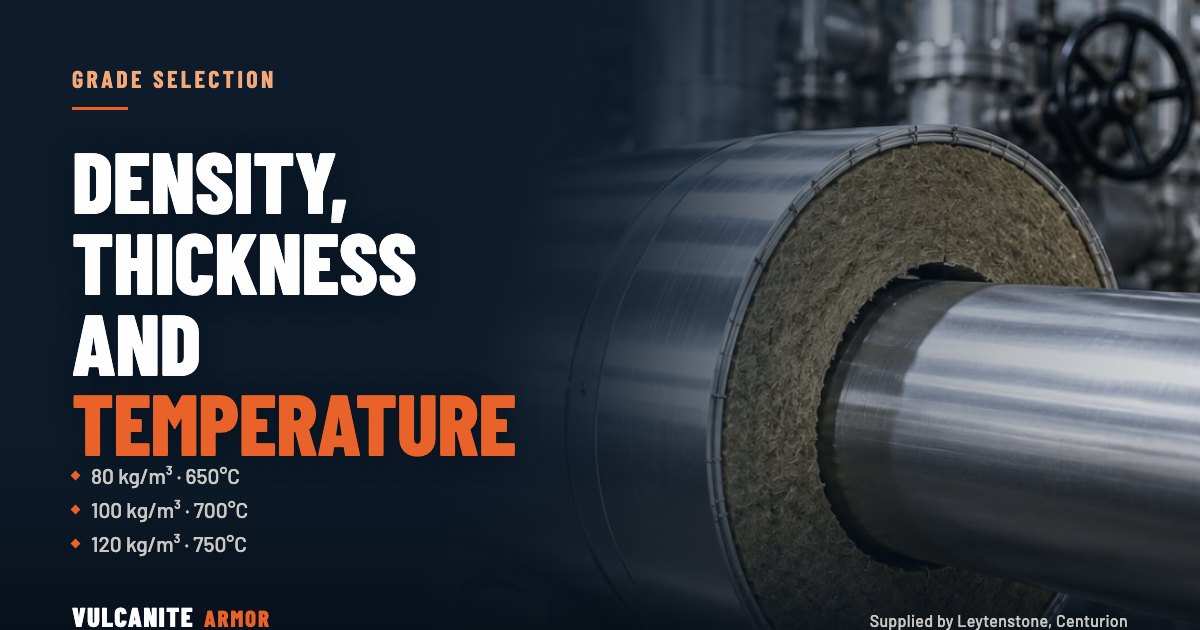
Which grade goes onto the line is a separate question, decided by the hot-face temperature: see choosing rock wool density and thickness. The pipework, vessel, duct and boiler applications the grades cover are listed in what rock wool is used for.
What Vulcanite Armor publishes
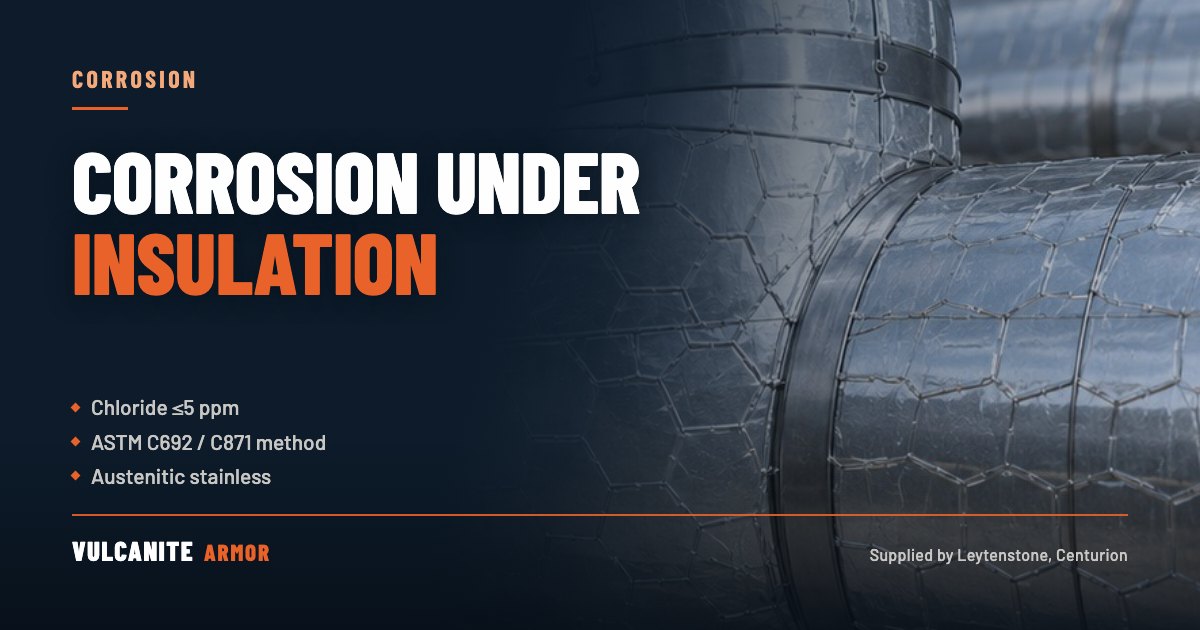
Vulcanite Armor publishes chloride ion content of 5 ppm or less, and the datasheet states that it conforms to the stainless steel corrosion specification as per ASTM C692 and C871 test method, with ASTM C692 and C795 in the standards column. Water absorption is published as less than 1 kg/m² by partial immersion, to EN1609 / BS 2972. Water vapour sorption is 0,4% or less by weight for rock wool blanket 100 kg/m³ and 0,2% or less for rock wool blanket 120 kg/m³, per ASTM C1104, and no figure is published for rock wool blanket 80 kg/m³: ask us before specifying that grade in a vapour-critical application. What that set of figures does is narrow. A low leachable chloride figure speaks to the insulation as a chloride source. The water, the tensile stress and the substrate sit outside what any datasheet line can report.
Preventing corrosion under insulation: cladding, sealing, drainage and vapour barriers
Cladding and sealing
The National Insulation Association, in a 2008 article, puts jacketing first, system maintenance second and a coating on the pipe third, and the 2022 review calls it the first external line of defence. Most water enters at details rather than through the sheet. The review requires jacketing, joints and irregularities to be carefully sealed, and traces one documented pipework failure to a degraded sealing system. The everyday version is dented jacketing and brittle caulk at butt joints.
Drainage and vapour barriers
Water that gets in has to be able to leave, and the only drainage evidence in these sources is the weep hole. API RP 583’s public contents name annex figures on diverting water from critical locations and avoiding build-up at supports, nozzles and gussets. On vapour barriers, the National Insulation Association records that moisture condenses on any surface below the dew point, including on a vapour retarder, and that dual-temperature and cycling systems are the difficult ones.
What the insulation contributes, and what it does not
Water absorption and water vapour sorption are material properties. They describe how a material behaves once water has reached it, not a substitute for a weathertight system, which is where Vulcanite Armor’s water absorption figure above belongs. A 2008 Insulation Outlook article puts the boundary plainly: any insulation material can be used effectively up to its design temperature if water is kept out of the system, and blaming the materials for damage that followed water ingress puts the blame where it does not belong.
For cracking on austenitic stainless, the controls are mostly not about insulation chemistry. The Institute of Corrosion lists stress relief and shot peening, coating before insulating or labelling, no labels or adhesives high in chloride or other halogens, low-chloride hydrotest water with prompt dry-out, and no stagnant regions where chloride can concentrate.
Inspecting for corrosion under insulation
Inspection starts by deciding where to look. The National Insulation Association describes risk-based inspection as setting frequency, scale and scope from the likelihood of corrosion, the rate observed historically and the consequence of a failure. The 2022 review names the locations to rank first: the 6 o’clock position, joint areas, and equipment near sprinkler systems.
Finding the damage means opening the system: the main method in use is visual inspection after partial or complete removal of jacketing and insulation, with infrared thermography, radiography, ultrasonic inspection and eddy current as the common screening techniques. A US regulator has recommended expanding inspection programmes to cover all insulated components, which may require removing the insulation.
Hold the two mechanisms apart when the results come back. None of these sources splits the technique list by substrate, and a thickness figure answers a metal loss question. The 2022 review records carbon steel damage as metal loss and stainless damage as pitting and cracking. It follows, though no source read here states it, that a measurement built to quantify wall thickness is not built to find a crack.
Getting the chloride line and the grade for your stainless pipework
Corrosion under insulation is a water problem with two damage mechanisms, and a chloride figure speaks to one of them, as one contributor among several. What each wool class publishes, and where rock wool is the wrong answer, is in rock wool vs glass wool vs ceramic fibre.
Download the Vulcanite Armor datasheet for the chloride line, the conformance statement and the sorption figures on the three Vulcanite Armor grades. Send us the substrate, the line temperature and the pipe diameter and we will confirm the grade and thickness: get a quote.
Frequently asked questions
At what temperature range is corrosion under insulation most likely?
Published ranges disagree, so treat any single band as one source's figure rather than as a rule. A 2022 peer-reviewed review reports 50 to 175°C as documented in NACE SP0198 and API RP 583, and applies that one range to carbon steel and austenitic and duplex stainless together. Trade sources print other bands in °F. The condition is the usable part: liquid water at the metal surface.
Does rockwool cause corrosion on stainless steel?
No: water does, and any insulation holds it against the surface and hides it. Cracking on austenitic stainless needs a susceptible alloy, a tensile stress and a chloride-bearing wet film together. Leachable chloride in the insulation is one chloride source among several, alongside airborne salt, process water and wash water. Where a film evaporates on a hot surface, a few ppm can concentrate to hundreds of ppm.
What is the chloride limit for insulation on stainless steel?
This page prints no limit. The specification that governs the question is ASTM C795, Standard Specification for Thermal Insulation for Use in Contact with Austenitic Stainless Steel, and its acceptance criteria sit inside the paid standard. ASTM C871 is the analysis method for leachable chloride in insulation. Vulcanite Armor publishes chloride ion content of 5 ppm or less as its own published value, not as compliance with a limit we have not read. Leachable chloride measured on dry insulation and chloride in a film on a hot pipe are different quantities measured on different things.
Does low chloride rockwool insulation prevent stress corrosion cracking?
No. Cracking on austenitic stainless needs a susceptible alloy, a tensile stress and a wet chloride-bearing film at the surface at the same time. A low leachable chloride figure removes one contributing source of chloride. It does not keep water out of the system, it does not remove the tensile stress, and it does not change the substrate. The Institute of Corrosion records that there is no lower limit of chloride concentration for crack initiation.
How do you inspect for corrosion under insulation?
Rank the lines by service and location first, then open the high-risk points. The 2022 review records visual inspection after partial or complete removal of jacketing and insulation as the main method in use, with infrared thermography, radiography, ultrasonic inspection and eddy current as the common screening techniques. No source read for this post splits that technique list by mechanism.
Is rock wool suitable for austenitic stainless steel pipework?
Nothing on a datasheet decides that. The specification that governs insulation in contact with austenitic stainless steel is ASTM C795, and its acceptance criteria sit inside the paid standard. The Vulcanite Armor datasheet states that it conforms to the stainless steel corrosion specification as per ASTM C692 and C871 test method, with ASTM C692 and C795 in the standards column, and publishes chloride ion content of 5 ppm or less. Whether a line is at risk is decided by the substrate, the stress, the temperature and whether water reaches the metal.
Published by Vulcanite, supplier of Vulcanite Armor rock wool insulation.
Need help choosing a grade?
Prices per roll are published for all three grades, or email us your hot-face temperature, dimensions and roll count for a written quote.