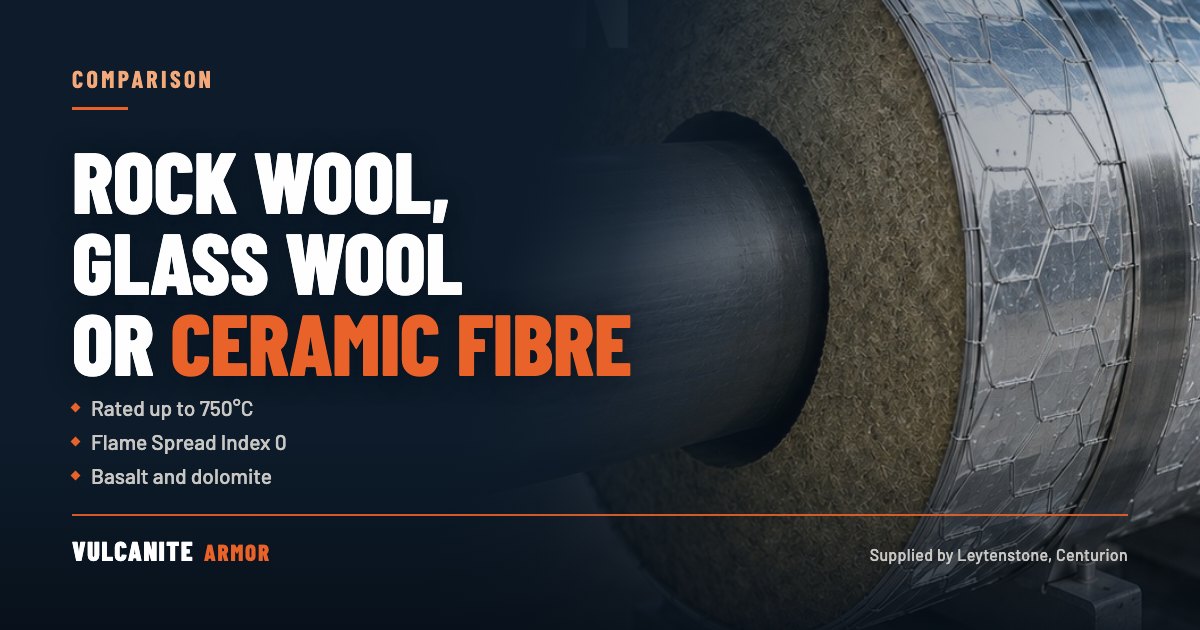
Glass wool is declared for building fabric and low-temperature service. Rock wool wired mat covers the industrial mid range on pipe, vessel, duct and casing work: Vulcanite Armor publishes 650°C, 700°C and 750°C hot-surface performance per ASTM C411 / C447, one figure per grade. Ceramic fibre, properly called alumino silicate wool, lines furnaces and kilns above that band.
What separates them is the temperature the material has to hold and the geometry it has to follow. The three classes also do not publish the same quantity, so the figures below are not like for like.
The three wools, side by side
Read the table by column. The rock wool column carries Vulcanite Armor datasheet figures; the other two carry material-class statements and figures declared on other parties’ documents, each linked.
| Glass wool | Rock wool (Vulcanite Armor) | Ceramic fibre | |
|---|---|---|---|
| Fibre feedstock | Sand, limestone and soda ash | Basalt and dolomite (datasheet) | Melted alumina and silica |
| Where it belongs | Building fabric, HVAC and low-temperature work | Industrial pipe, vessel, duct and casing work (datasheet) | Furnaces and kilns, fire protection, automotive exhaust |
| Published temperature figures, and what each one measures | Maximum continuous service temperature, declared per product: 300°C and 340°C on two manufacturers’ documents | Hot-surface performance per ASTM C411 / C447, per grade: 650, 700 and 750°C (datasheet) | Classification temperature declared under EN 1094-1: 1260°C on the data sheets consulted, with a lower continuous use temperature printed beside it |
| Usual form factors | Rolls, batts, boards and slabs, and preformed pipe sections | Blanket, mesh-covered blanket, board, pipe section. Vulcanite Armor is the wire-mesh stitched blanket only | Bulk wool, blanket, modules, board, paper, felt, vacuum-formed shapes |
| IARC Monographs Volume 81 (2002) | Insulation glass wool and continuous glass filament: Group 3. Special-purpose glass fibres such as E-glass and “475” glass fibres: Group 2B | Rock (stone) wool and slag wool: Group 3 | Refractory ceramic fibres: Group 2B |
The omissions are deliberate. The three temperature figures are not on one axis: they are three quantities measured three ways. There is no reaction-to-fire row and no water row, because no comparable published figure was found for all three classes. There is no conductivity row and no cost row: this page publishes no conductivity figure, and no cited public price exists for the other classes. Whatever the class, the same five lines are worth finding on the datasheet: the temperature figure with its test method beside it, the density figure with its method, the compliance specification, the chloride figure in ppm with its method, and water absorption.
Glass wool insulation: building fabric and low-temperature service
What glass wool is made of
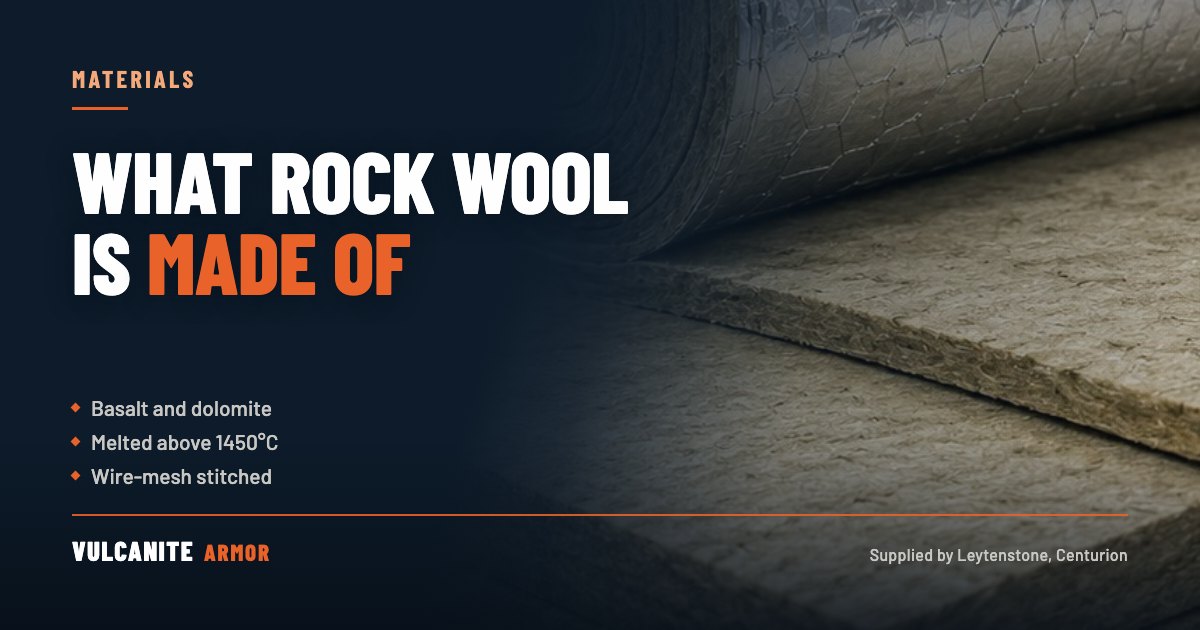
Glass wool and rock wool come off the same kind of line with a different mineral in the melt. EURIMA lists the glass wool feedstock as sand, limestone and soda ash, and the stone wool feedstock as basalt, diabase and dolomite. The process itself is set out in what rock wool is made of.
Where it is used, and what limits it
Glass wool insulation, spelled fibreglass in South African and British usage and fiberglass in American, is the class specified for building fabric, ceilings and ducting: one manufacturer’s technical documentation places it in building insulation, HVAC and low-temperature work. Two maximum continuous service temperatures were found on technical documentation for glass wool products: 300°C on one manufacturer’s page and 340°C for a rigid sectional pipe insulation on another. Both are product declarations. No standard was found that sets a service temperature for glass wool as a class, so a figure off one sheet describes that product.
A second limit travels with faced products: the same document records that the temperature tolerance of the facing adhesive limits the surface temperature to 70°C. A faced product carries two ceilings, and the specification must clear both.
Rock wool: industrial pipe, vessel and duct work
What rock wool is made of
IARC records that the traditional raw materials for rock wool are basalt or diabase mixed with a fluxing agent such as limestone or dolomite. The Vulcanite Armor datasheet names basalt and dolomite. IARC also sets the naming rule: where blast furnace slag is the primary component of the melt the product is slag wool, and where basalt is, it is rock wool. Neither name is a verdict on quality.
The published hot-surface figures
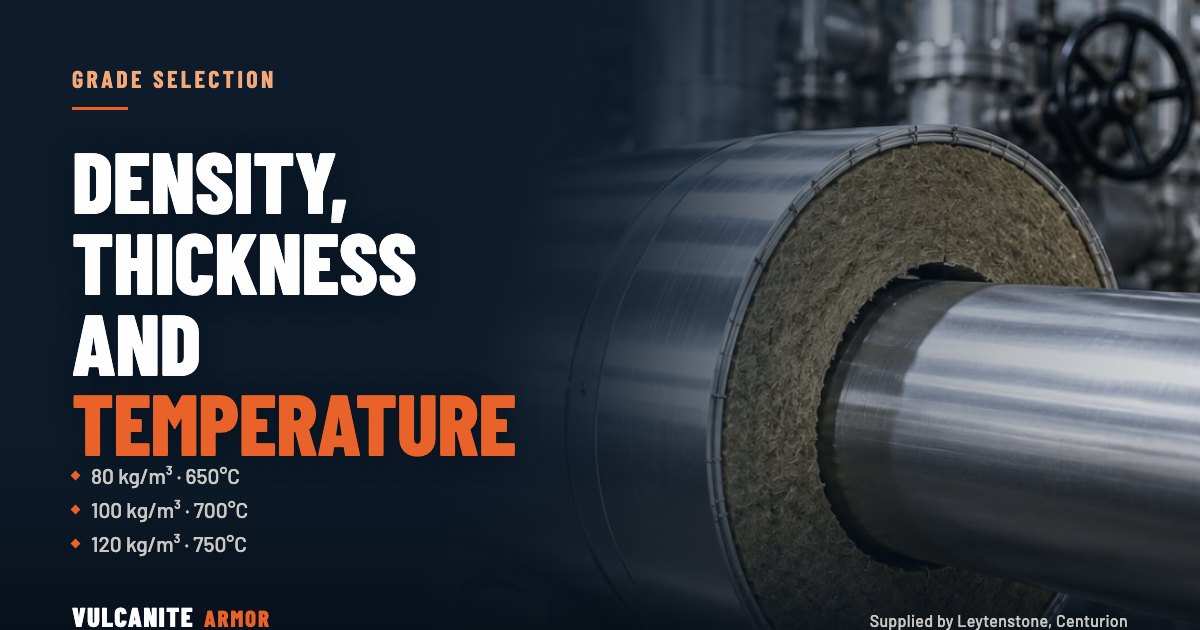
| Grade | Density (EN1602) | Hot-surface performance (ASTM C411 / C447) |
|---|---|---|
| rock wool blanket 80 kg/m³ | 80 kg/m³ | 650°C |
| rock wool blanket 100 kg/m³ | 100 kg/m³ | 700°C |
| rock wool blanket 120 kg/m³ | 120 kg/m³ | 750°C |
The range is rated up to 750°C. That 750°C figure belongs to Blanket 120 and to no other grade, which is why the range statement and the grade statement stay separate sentences. Which grade a line selects, and the thickness that follows, is worked through in choosing rock wool density and thickness. Which applications sit inside that band is covered in rock wool industrial applications.
What the wired mat does that a board or a batt does not
Vulcanite Armor is stitched to galvanised or stainless steel mesh, 24# or 22# wire with 1 inch mesh, 30 to 100 mm thick and 600 or 1200 mm wide. The mesh is what lets a flexible mat follow conical, cylindrical and irregular geometry. Rock wool is also made as pipe section, board and block, each under its own ASTM specification, but Vulcanite supplies the stitched blanket only.
Ceramic fibre blanket: furnace linings and the top end
What ceramic fibre is
Refractory ceramic fibre is a different material class from mineral wool rather than a hotter version of it. ECFIA, the European association for the high temperature insulation wool industry, describes alumino silicate wool, also known as refractory ceramic fibre, as amorphous fibre produced by melting alumina and silica, and prefers that name because it describes the composition. Products made from it are generally used above 900°C, and the blanket is held together by needling rather than by a wire mesh.
What “1260” on a ceramic blanket actually designates
It is a classification temperature, not a running temperature. These products are classified under BS EN 1094-1:2008, Insulating refractory products. Terminology, classification and methods of test for high temperature insulation wool products. The number inside a product name is the figure declared under that standard, and data sheets print a second, lower figure beside it. One 2016 data sheet pairs each classification temperature with a continuous use temperature: a blanket classified at 1260°C carries 1093°C there, and a 2025 sheet pairs 1260°C with 1180°C. Trade press gives the rule behind the gap: continuous use temperatures run at least 150 to 200°C below the classification temperature, with the standard high purity grade rated around 1260°C maximum and 1180°C continuous use.
So a 1260 blanket does not run at 1260°C. Ask for the continuous use figure, and the document it came off, before that number reaches a specification.
Reaction to fire, and where the comparison stops
Vulcanite Armor publishes a Flame Spread Index of 0 and Smoke Developed 20, tested per ASTM E84, and the datasheet states that it “holds ISO, CE and A1 certification approval”. That is the datasheet’s own wording, quoted as printed. It does not name the standard the A1 refers to, and no reaction-to-fire declaration of our own is published. An independent research institute records that ASTM E84 evaluates surface burning characteristics, and that a Flame Spread Index of 0 to 25 with a Smoke Developed Index of 450 or below meets Class A.
In Europe the standard is BS EN 13501-1:2018, Fire classification of construction products and building elements. Classification using data from reaction to fire tests, and products meeting Euroclass A1 are considered non-combustible. One manufacturer publishes its glass wool products at A1 when tested to it, while a second publishes its glass wool products as Class A1 or A2. Note the hedge: the class is declared per product, so the figure that counts is the one on that product’s own declaration.
For refractory ceramic fibre, no reaction-to-fire classification was found on any document consulted for this post. That is a gap in what we could source rather than a finding about the material, and the likely reason sits in the two standards’ printed titles: EN 13501-1 classifies construction products, EN 1094-1 classifies insulating refractory products, and a ceramic fibre blanket is declared against the second. That is reasoning rather than a sourced claim, and it is why the table carries no fire row.
Moisture: three quantities, three methods
One statement is common to all three: moisture transport changes the thermal insulation properties of fibrous materials generally. That study compared mineral wool with cellulose and wood fibre. It says nothing about glass wool or ceramic fibre, and no figure in it transfers to this comparison.
Vulcanite Armor publishes water absorption of less than 1 kg/m² by partial immersion to EN1609 / BS 2972, and water vapour sorption of 0,4% or less for Blanket 100 and 0,2% or less for Blanket 120 per ASTM C1104. No sorption figure is published for Blanket 80, so ask before specifying that grade in a vapour-critical application. Beyond those figures the three classes cannot be compared on a common basis: the documents found measure three quantities by three methods, and one class publishes no number at all.
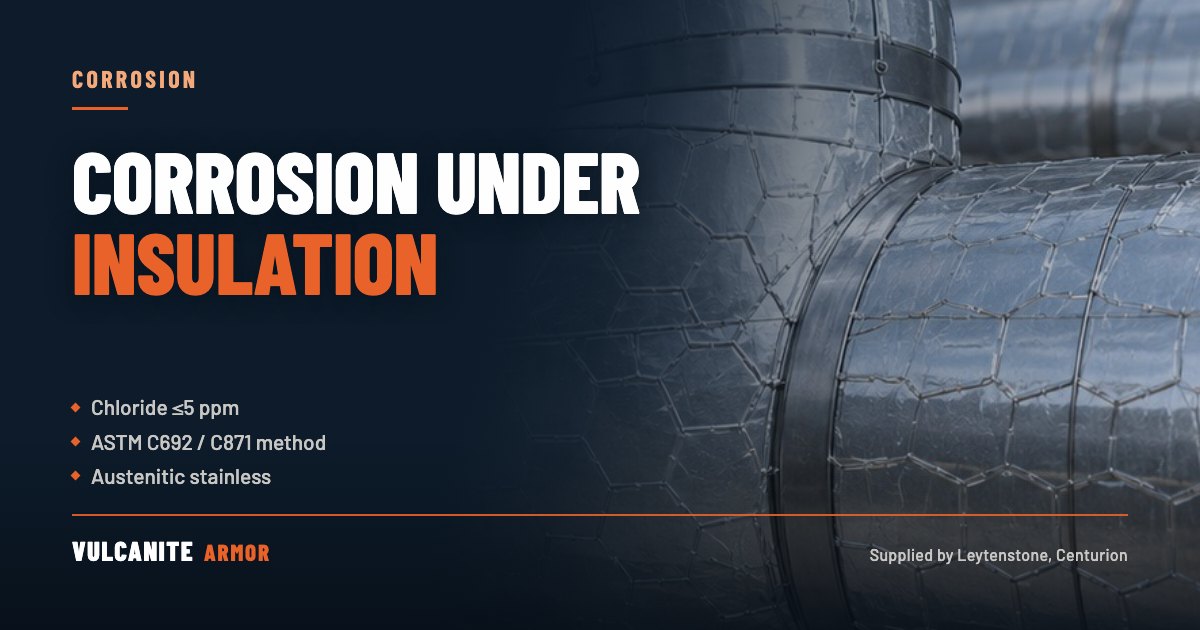
The boundary matters more than the figures. Any insulation material can be used effectively up to its design temperature if water is kept out of the system. What wet insulation does to steel is set out in corrosion under insulation and chloride on stainless steel.
Handling and health classification
This section is about these materials as classes, reported from their sources. It is not a claim about Vulcanite Armor.
What IARC records
First, what a hazard classification is. It is a statement about the strength of the evidence that an agent can cause cancer, not a measure of risk at a given exposure and not a ranking of products. Group 3 means the evidence was not sufficient to place the agent in another group.
IARC Monographs Volume 81 (2002) states: “Insulation glass wool, continuous glass filament, rock (stone) wool and slag wool are not classifiable as to their carcinogenicity to humans (Group 3).” The same evaluation states: “Refractory ceramic fibres are possibly carcinogenic to humans (Group 2B).” It places special-purpose glass fibres such as E-glass and “475” glass fibres in Group 2B too, so the Group 3 entry covers insulation glass wool rather than all glass fibre. Behind that entry IARC records inadequate evidence in humans and limited evidence in experimental animals for rock (stone) wool and slag wool. The page lists a previous evaluation in Volume 43 (1988).
The two material classes therefore sit in different IARC groups, and that is a difference in how the evidence was classified rather than a verdict on either material in use.
The EU layer on top reads differently. EU-OSHA records that mineral wools carry an Annex VI entry under index number 650-016-00-2 and a Carc. 2 (H351) classification, with Note Q allowing that classification not to apply where defined biopersistence criteria are met. ECFIA’s regulation pages state that alumino silicate wool carries a separate Annex VI entry, index 650-017-00-8, at carcinogen category 1B with the label phrase “may cause cancer by inhalation”, and that the Note Q route is described against the mineral wool entry. That account comes from the association representing the material’s manufacturers, because the primary EU sources could not be reached. These are two separate Annex VI entries for two separate substances. They are classifications of hazard, not a ranking of materials, and whether Note Q applies to any given product depends on biopersistence data held by that product’s manufacturer, which this page does not hold for any product.
What that means on site
Published practice is the same in kind across all three classes. EU-OSHA lists ventilated cutting devices, general ventilation, dust removal, and loose-fitting FFP1 respiratory protection with goggles for dusty or overhead work, and 2005 construction guidance adds an N95 respirator, goggles, loose-fitting clothing and gloves, with cutting by sharp knife rather than tearing. ECFIA reaches the same practice from the high temperature side and adds the one real difference: the level of control follows the classification and the relevant exposure limits. For alumino silicate wool, classified Carc. 1B in the EU, the published guidance is that substitution is considered first, under a binding exposure limit value of 0,3 fibres per millilitre. Product-specific handling information sits on the supplier’s SDS.
The other classes on the same job
All three wools sit in NIA’s fibrous group, while calcium silicate sits in its granular one. Calcium silicate is a rigid block and pipe product rather than a flexible mat: ASTM C533 covers it for surfaces between 80°F and 1700°F, which is 27°C to 927°C. From the same guide, ASTM C578 covers rigid cellular polystyrene up to 165°F (74°C) and ASTM C591 covers rigid cellular polyisocyanurate up to 300°F (149°C), grading its types by compressive resistance from 16 psi to 125 psi. The difference is in what is graded: the rigid classes on compressive resistance, the wools on density and temperature.
Where rock wool is the wrong answer
Where the ranges overlap, four things decide rather than a headline number: whether the geometry wants a mat or a board, what the plant specification names, whether the system can be kept weathertight, and what the QA file accepts as evidence. Cost is not among them, because no cited public price exists for the other classes.
Above the published hot-surface figures. Blanket 120 is published at 750°C. A furnace lining, a kiln or a heat-treatment door seal above that band is not a rock wool blanket job: the class changes rather than the grade, and alumino silicate wool is the class specified there, generally above 900°C.
Light building work. For loft, stud wall, ceiling and partition work, glass wool is the class normally specified, supplied in rolls, batts and slabs sized for those cavities. A wired mat is the wrong form factor there. Where noise rather than heat is the reason for filling that cavity, what the material does and does not do is set out in rock wool for sound insulation.
Below-ambient and condensation-critical service. The deciding criterion changes. NIA records that on below-ambient pipes the overriding concern in almost all applications is preventing surface condensation, and that vapour drive to a cold surface creates strong potential for insulation saturation, which is why a class published at zero perm-inch permeability was taken up for cold service.
Compressive and load-bearing duty. Where the specification grades on compressive resistance, or calls for a board or a preformed section under a support shoe, the rigid classes carry that graded figure. None is published per grade on the Vulcanite Armor datasheet, and Vulcanite supplies neither boards, pipe sections nor loose wool.
Where water cannot be kept out. If the system cannot be kept weathertight, changing the wool is not the fix, and nothing on this page solves it.
Where the plant specification names a different class. A QA file naming calcium silicate on the hot face is not an argument to win on a blog.
Rock wool’s band is the industrial mid range on pipes, vessels, ducts and casings. Outside it, other classes are specified for good reasons.
Getting the grade for your line
Download the Vulcanite Armor datasheet for the published figures on the three grades, priced on the published price list. Send us the line temperature and the pipe or casing dimensions to get a quote carrying the grade and a thickness band.
Frequently asked questions
Is rockwool better than fibreglass?
Neither ranks above the other, because the two classes publish different quantities and are specified in different form factors. Glass wool is declared for building fabric, HVAC and low-temperature work. Rock wool wired mat covers industrial pipe, vessel, duct and casing work, and Vulcanite Armor publishes 650°C, 700°C and 750°C hot-surface performance by grade per ASTM C411 / C447. The line temperature and the geometry decide, not a ranking.
Is rockwool safer than fibreglass?
The difference a buyer expects here is not in the classification. IARC Monographs Volume 81 (2002) places insulation glass wool and rock (stone) wool in the same category, Group 3, not classifiable as to carcinogenicity to humans. In the EU both carry the same Annex VI entry at Carc. 2 (H351), with Note Q. Published handling practice is the same in kind for both.
When do you need ceramic fibre instead of rock wool?
Above the published hot-surface figures of the rock wool grade. Vulcanite Armor publishes 650°C for Blanket 80, 700°C for Blanket 100 and 750°C for Blanket 120 per ASTM C411 / C447, and the range is rated up to 750°C. Above that band the material class changes rather than the grade: alumino silicate wool products are generally used above 900°C in furnaces and kilns.
What is a ceramic fibre blanket?
It is a needled mat of alumino silicate wool, the material also called refractory ceramic fibre, used for furnace and kiln linings. ECFIA describes the wool as produced by melting alumina and silica. Data sheets for these blankets publish a classification temperature and a lower continuous use temperature beside it.
Is mineral wool the same as glass wool?
Mineral wool is the category, and glass wool is one member of it. EURIMA lists glass wool, stone wool and slag wool together as mineral wool insulation. What separates the members is which mineral dominates the melt: sand, limestone and soda ash for glass wool, basalt and a carbonate flux for rock wool, blast furnace slag for slag wool.
What is an alternative to rockwool insulation?
It depends on the band. Glass wool is the class normally specified for building fabric and low-temperature service. Above the rock wool hot-surface figures the class becomes alumino silicate wool. Where the specification grades on compressive resistance or calls for a rigid board, calcium silicate and the rigid cellular classes carry that figure. This page carries no cost comparison, because no cited public price exists for the other classes.
Published by Vulcanite, supplier of Vulcanite Armor rock wool insulation.
Need help choosing a grade?
Prices per roll are published for all three grades, or email us your hot-face temperature, dimensions and roll count for a written quote.